Showing posts with label Medieval textiles. Show all posts

Friday, 27 February 2015

Weaving Vadmal V - The Finished Fabric

In medieval times, the fulled fabric was stretched on tenterhooks while still damp to get its final shape (from which we get the English expression 'to be on tenterhooks'). Not having a tenter around, or even a wall on which to nail my fabric, I had to make do with the slightly more modern finishing treatment of rolling it on a plastic tube instead. And re-rolling it once a day until it was completely dry. Normally, this wouldn't have been a problem. As it happened, me and boyfriend J-E were leaving to go backpacking in Switzerland the day after I returned from the fulling mill... No time for the fabric to dry.

Rolling the fabric (or keeping it stretched out) while it dries is rather important to get a good finish and remove any wobbliness introduced into the fabric by the violent fulling process. Skipping this stage was not something I wanted to do after spending so much time and effort on my fabric... Letting it dry on the plastic tube was not an option either; I didn't want to risk it going mouldy in my abscence! Eventually, I resorted to a kind of speed drying that worked surprisingly well: The house we live in has room for drying laundry in, equipped with a great big hot air fan. I stayed up all night (more or less), re-rolling my fabric every couple of hours, letting it sit on the plastic tube in the drying room in between.

Fabric. On a roll!
The result was that, by morning, my fabric was completely dry and had been stretched and rolled just as many times as it would have been had I done it the proper way. And it was nice and smooth too. Success!

After two weeks of trains, medieval churches struck by iconoclasts and quite a few alps and weird biscuits, I was back home and ready to cut my cloth. 

Swiss Collage: Best train ride ever! - Neuchâtel tomb - Happy Swiss biscuits
I used the body block I made for my supportive shift as a basis for cutting out the pieces. I've made enough dresses of this rather simple late 14th century style for myself to know how they work on my body, so these days, I usually do the fitting on myself with the real fabric, skipping the mock-up stage. I prefer dresses without back and front seams, so all the tweaking to get the fit right is done in the side and shoulder seams. Cutting with a little extra seam allowance in those areas gives me enough room to do the necessary adjustments. For this dress, I wanted to have lacing down the front, but I still put all the shaping into the side seams. I calculated that I could get at least two long-sleeved dresses out of my fabric, and probably something small like a hood, if I cut it economically. Eager to get going, I cut. 
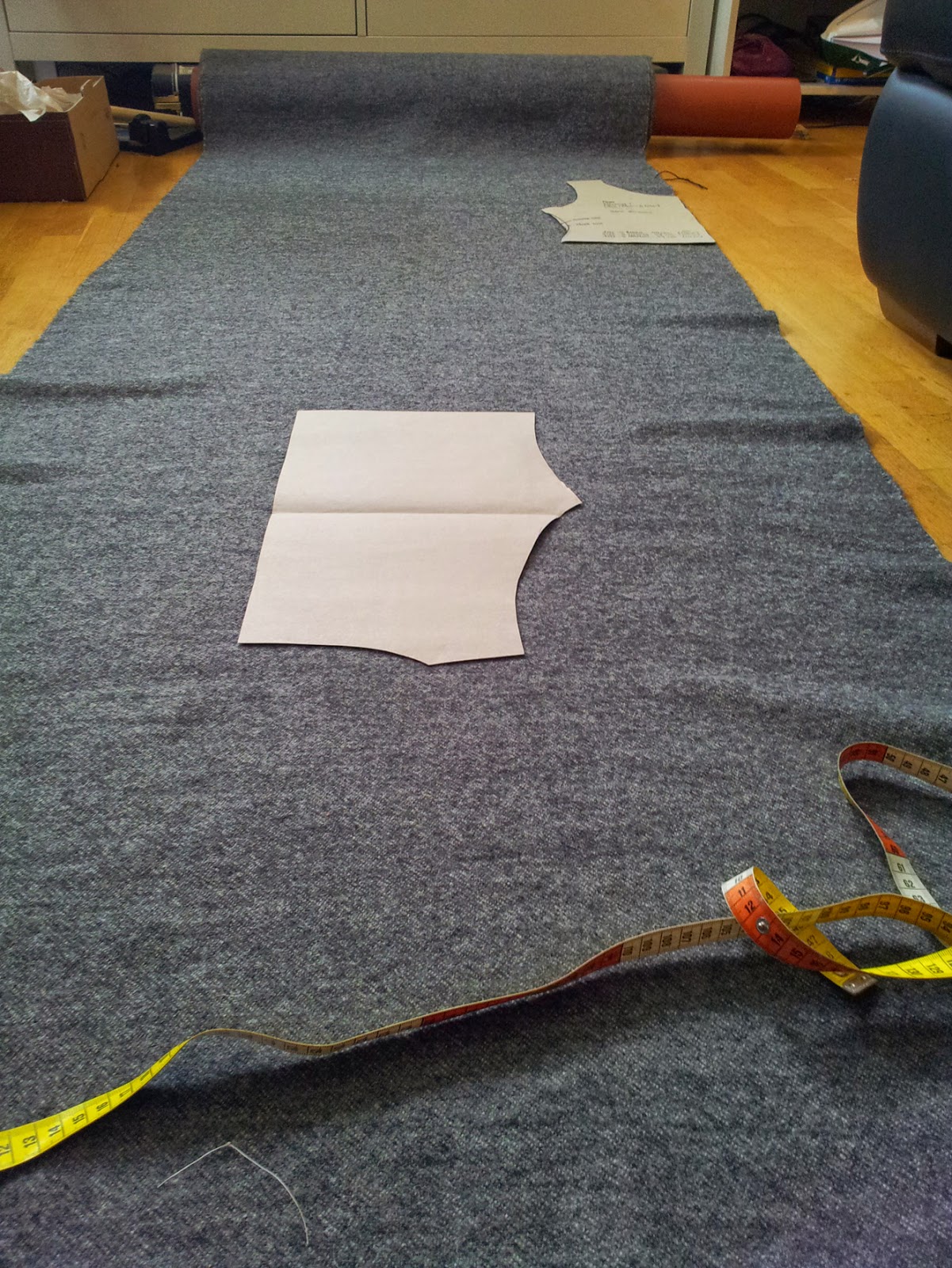
 
Pattern pieces
The first cut! The brown thread marks one of the three weaving faults in my cloth...
And then realised that I should probably have added at least another centimetre of extra seam allowance since I was going to dye the damn things too! Mordanting and dyeing the cut pieces would almost certainly wreak havoc on the raw edges and ruin my precious seam allowance... Ah, well. I threw them in the dye pot anyway.

I had enough madder left for a weak 14% dye. This wouldn't be the bright red I got on my sample, but I was fine with that. I just didn't want a completely grey dress... Still, I was surprised by how strong the colour ended up – not a muted, watered-down pink like I had expected, but a cheerful orange, only tempered by the dark weft! The edges did fray, but not too badly. The seam allowance on the Herjolfsnes garments is about 7 mm and there was at least twice that left, so I had no reason to complain. 
 
Both the colour and the frayed edges turned out a lot better than expected
Despite this vadmal project, spinning was really my main focus last year (I just realised I've spent almost 5 years just practising spindle spinning! My blog post from 2010 sounds awfully naive, now!). I finally mastered (well, sort of) spinning with a distaff, which seemed like a necessary skill to accquire if I wanted to spin the way it was done in medieval times (there are practically no medieval depictions of spinners not using a distaff) and I tried my hand at producing sewing thread.
 
A slightly hairy thread...
I could probably make it thinner with more practice (after all, the 2-ply sewing thread from the Herjolfsnes garments is less than 1 mm in diameter), but it turned out to be a perfect thickness for my vadmal fabric as it was. My sewing thread has a lot of give in it; I think this will be a very good thing for a tight dress. The thread will take a lot more strain before breaking than the 2-ply linen I usually use for hand sewing.

All that's left now is for me to finish the dress... And decide what to do with the rest of the fabric!

Felling the shoulder seam à la Herjolfsnes

To sum things up: 
My version of a medieval vadmal fabric ended up with the following technical specifications after fulling, drying and dyeing: 

Weave type: 2/1 twill 
Warp: light natural grey 1-ply wool, z-spun, 9 threads/cm 
Weft: dark natural grey 1-ply wool, z-spun, 10 threads/cm
It was fulled in cold water for approximately 4 hours, with a total shrinkage of 10% (width) 
Finished width: 82 cm 
Finished length: ca 11 m
Dress pieces dyed with 14% madder.

Next time: Weaving Vadmal VI - The Dress

Wednesday, 15 January 2014

Spinning Blues!

"I knew they were crazy, those Finns, but blue sheep? Really?!", said boyfriend J-E when he came home yesterday and found me with an impressive fluffed-up cloud of blue wool. 

I told him, "The Finns don't have blue sheep, however, they've got Mervi" (of the Hibernaatiopesäke blog).

Jaala sheep's wool, dyed with woad.
I got this sample of wool from the Jaala sheep from Mervi this summer. She had dyed it with her own home-grown woad! The result: deliciously blue wool that was begging to be spun. 
The wool: very soft and short-stapled. And blue.
The dyed wool was very fine, with an average staple-length of about 4 cm. Since I wanted to be able to use as much of it as possible (preciousss fibresss...), I decided to make a proper effort preparing it. To get a nice, even colour I first needed to mix all the fibres thoroughly. I did this by pulling the staples apart by hand and turning the wool into the fluffy cloud of blue that my boyfriend commented on. In Swedish, this is called tesning. I then chose, rather counter-intuitively, to comb the wool rather than carding it. Combing wool this short is not the usual practice these days, but it's very probable that it was prepared in this way in medieval times. The use of wool cards in the middle ages is a rather interesting, not entirely straight-forward subject. The comprehensive history of wool cards goes something like this, according to John Munro (who sadly passed away recently):

Wool cards arrived in Europe during the later part of the 13th century, probably borrowed from the Islamic cotton industries in Spain or Sicily. Some historians argue that cards were being used as early as mid-11th century, but, according to Munro, it's unclear whether they refer to wool cards or fullers' cards, used to raise a nap on fulled cloth. Wool cards, as we know them, were quickly banned from use in many (not all) of the professional textile centres around Europe, at least for the production of high-quality cloth. In some places, carded wool was allowed in the weft yarn, but not for the warp (just like the use of the great wheel for spinning the thread). Later, in the 15th century, several of these bans were lifted, although many producers continued using only combed wool for their cloths. (Munro 2003, in The Cambridge History of Western Textiles).

This information is all about wool cards and their use in professional cloth production. But how widespread was the use of cards (and the great wheel, for that matter) among everyday spinners, who didn't spin for the big textile centres? When was the use of cards established in my native Sweden? Did we even use them here in medieval times?! I haven't managed to answer any of these questions. It doesn't help that in both English and German, the medieval word for cards/karden is also used for the teasel heads more commonly associated with raising the nap on fulled cloth. Some books (and about 10 million webpages) actually refer to teasels being used for carding wool, too, but I'm not entirely convinced. I've yet to see a reliable source, or someone who's actually carded a whole fleece with teasels. I have a suspicion that the strain of carding raw wool would be a bit too much for the teasels, but then again, I might be wrong.

(please prove me wrong! either with a good, solid reference or by a practical test. I have a bunch of teasel heads from Dipsacus sativus - the cultivated teasel that is used for finishing cloth - but no time to try them out myself at the moment...)

Anyway. The questions above, together with my general interest in trying things out, made me reach for my combs rather than my cards to prepare the very short Jaala wool. Here's the result.
The short and slubby leftovers and the combed rolled-up fibres, ready to spin.
Almost half of the wool ended up in the leftover pile. The very fine fibres had a tendency to stick together and form slubs, but once I had combed through a batch, it was easy to remove the slubs before pulling the rest of the fibers off the combs. To compare, I carded a tiny bit of wool too, but it turned out much more slubby and uneven. Even with fibres this short, combing worked wonderfully. It would have been better if my combs had had finer and more closely-spaced tines to match the fibre quality, but on the whole I'm happy with the result. Spinning the combed rolags was quick and easy!

Most of the leftover fibres are only a couple of centimetres or less, so I will first draft them into a fluffy semi-thread by hand before taking them to the spindle. It makes the short and lumpy wool easier to handle, but it also takes a lot of time and I have several hours left before I'm finished. So, back to work, and a great big thank you! to Mervi for giving me the spinning blues... ;-)
A spindleful of blue, and the beginnings of the last batch.
Edit 2014-01-31: In the comments below, Panth of the In My Lady's Chamber-blog linked to two post about teasels and cards. Read them - they're well-written and well-researched and sheds some more light on the subject of wool preparation!
Teasels for carding - a myth? 

Teasels: a quick note

References:
Jenkins, David T. (red.). 2003. The Cambridge history of western textiles. 1. Cambridge: Cambridge Univ. Press.

Saturday, 25 June 2011

Work in Progress - The Dune Belt

I'm weaving again!

In my NESAT X article about the so-called Eric of Pomerania's Belt and the Dune Belt, I focused on the weaving technique and on the better preserved Eric of Pommerania's Belt. The fragmentary Dune Belt from Gotland mostly served as comparison, although it was actually because of it that I finally managed to figure out how the two belts were made and reconstruct the previously unknown tablet-weaving technique. Three years on, it's finally time for the Dune Belt to receive some long over-due attention. As it happens, this summer marks the 650-year anniversary of the Battle of Visby in 1361, when Danish king Valdemar invaded Gotland. The Dune treasure, in which the Dune Belt fragments were found, is believed to have been buried some time around the invasion.

On a side note: there will be a reenactment battle commemorating the events of 1361 on Gotland this summer: The Battle of Wisby. I will be there.

One of the Dune Belt fragments. Historiska Museet, Stockholm. Inv. No. 6849:68D.

It's difficult to say much about what the Dune belt originally looked like - no colours are preserved, as you can see in the image above, but the weave itself indicates some sort of diamond-shaped diagonal pattern. By focusing on the weave, I think it might be possible to get a better idea of how potential colours were distributed: changes in the pattern (the colours) result in changes in the acutal weave. So I've started weaving samples to see what kinds of colour changes will produce a weave that matches the fragments. So far I've made 5 samples, and I have a few more ideas to try out before going back to analyse the material and see what conclusions can be made (if any). The thread I'm using is Nm 60/2 spun silk, which is not quite right (the original is more like tightly twisted 320 denier filament silk, which I will get for the next set of samples), but it will do for now.

First sample. Loosely tensioned wefts, giving the weave an "Eric of Pomeriana"-look, rather than the tight "Dune"-look.
Second sample. Wefts pulled tighter, moving towards the "Dune"-look.
Third sample. Almost half the width of the first sample. Still not quite tight enough for the Dune Belt.

The pattern of the third sample really looks very nice! I like it a lot - imagine an entire belt dotted with those tiny diamonds!!! Unfortunately, it doesn't seem to match the fragments particularly well, but I won't rule it out completely until I get it under a microscope together with the original. I plan to put my results into a proper article when I'm done with all the samples and comparisons. In the meantime, the work-so-far will be exhibited during the huge weaving fair Väv 2011 in Borås, Sweden, this September (see this link for an English pdf-version of the programme)!


References and links: 

Holmqvist, V. "A Study of Two Medieval Silk Girdles: Eric of Pomerania's Belt and the Dune Belt", in  Andersson Strand, E. et al. NESAT X. Northern European Symposium for Archaeological Textiles. Oxford: Oxbow Books, 2010, 117-125.

An old post about weaving Eric of Pomerania's Belt:

Search the Collections, Historiska Museet (The Museum of National Antiquities):

The Battle of Wisby:

Väv 2011: Weaving Fair

Wednesday, 5 September 2007

Finishing old projects...


Today I finished an embroidery I've been working on for I don't know how long!
(I think a lot of people who are interested in medieval emobroidery and textiles will recognise the pattern - it's from a silk purse displayed in the textiles study room at the Victoria and Albert Museum in London. Timothy J. Mitchell's article on counted thread embroidery with drafts of this purse and others can be found on his homepage A Stitch Out of Time.)

The finished piece is less than half the size of what I originally intented it to be and it will be a very small purse indeed if I ever assemble it. When started working on it, I didn't worry too much about the materials and went for the cheepest option: mercerised cotton thread instead of real silk. At the time it seemed like the right decision to make, but after a while I realised that if I was going to wear this with my medieval clothing, I actually wanted it to be silk (or at least look like it, which this thread didn't)... By then I had done almost two thirds of what can be seen in the picture above, but I put it aside and ignored it successfully for years. This summer, in an attempt to relax after all the work with my thesis, I decided to finish it after all. I think I'll make it into a purse now while I'm at it and use it for my mobile rather than with my medieval outfits!

My thesis, by the way, will soon be available - I still have one image I need to check the copyright for before I can post it in the digital archive I mentioned in a previous post. Now the holiday's over I'll hopefully get round to it... After handing in my thesis in May, I continued working with Eric of Pomerania's Belt - there were still a couple of things I hadn't been able to explain properly. The analysis of the weave I present in my thesis is still correct (as far as I can tell), but the way I tried to recreate it isn't. But eventually I did figured it out - just in time to include the new findings in my paper proposal for the NESAT conference (North European Symposium on Archaeological Textiles) that takes place in May next year! When I got back from my vacation there was an e-mail in my inbox, telling me that my proposal had been accepted - yay! So whatever else happens this autumn (does anyone out there want to hire an archaeologist specialising in textiles ;-) ???!), I will still be here weaving Eric of Pomerania's Belt in my spare time. And if my research continues in the direction it's heading at the moment, I think I will have a rather interesting paper to present!

Sunday, 29 April 2007

My brain hurts...

Since my weaving is going very well I decided to turn my attention to the paper I have to write instead. I spent the better part of the day fiddling with the introduction and then tried to write the background instead. I seemed to have forgotten everything I had ever read on the subject of medieval girdles and had to sit down with the books again and take new notes. This also meant I had to re-translate the relevant parts of Ilse Fingerlin's book Gürtel des hohen und späten Mittelalters because I had no idea what they said anymore despite having read them all a month ago. It's very annoying, but I suppose that's what stress does to you...

I don't know any German, but luckily my native Swedish is similar enough to make reading it possible with the help of a dictionary and a lot of patience. Fingerlin has some interesting discussions concerning the dating of Eric of Pomerania's belt - she pushes it back to the 13th century, wheras Poul Nørlund and the National Museum of Denmark say it's 14th century (all of them agree that attributing it to Eric of Pomerania is completely wrong, though. But the name still sticks...).

Hopefully I'll manage to write something tomorrow instead. I have a meeting with my supervisor on Monday and it would be nice to have something written to show her, but it's a real struggle to write in English again. I haven't done it in years, but I thought it would be a good idea now since there's a lot of non-Swedish speaking people out there who might find my thesis interesting...

Tuesday, 24 April 2007

Practice makes...

...perhaps not perfect, but at least a whole lot better!

I changed the pattern for the gold thread (there's hardly anything left of it on the original belt, so I had to improvise a little) and started all over again with my sample piece. I have to show it in the graduation exhibition organised by the school, so I decided I needed something that can be displayed without having to cover up the first couple of centimetres of uneven picks...

And I'm much happier with this second piece - the "gold" thread looks a lot better and the proportions are closer to the original. I wove it in half the time it took me to do the first one too, so yay for me!

Here's a picture of the new and improved sample!

Thursday, 19 April 2007

So many threads, so little time...

My first full-scale trial piece of the "Eric of Pomerania's Belt"-weave is progressing slowly and I'm reasonably happy with it. The cheap spun silk I'm using as a substitute for the more appropriate reeled silk is a bit fuzzy and the fake gold thread doesn't cover the background very well, but otherwise it's working. I had a hard time pulling the weft tight enough to get the band down to the correct width today (approximately 3 cm). There are over 100 threads/cm and although the edges are nice and tight, the threads in the middle still look a little too spaced-out. But they do that in the original too, so maybe I shouldn't worry about it...

Here's a close-up of today's work. Remember it's only 3 cm wide!


Tuesday, 17 April 2007

Bachelor's Thesis Angst

I'm analysing the so-called "Eric of Pomerania's Belt" kept at the National Museum of Denmark for my bachelor's degree in handweaing. It's an extremely well-preserved silk girdle dated to the 14th century with a very complex weave. It's wonderful, fascinating work and I should be loving every minute of it. And I am. It's just that it's also incredibly slow work and I only have one month left before everything has to be finished..

The archaeologist in me wants to do a proper report with lots of background research and comparative material, but the powers that be at the University College of Borås where I study are more into textile design and product development so I'm worried that an archaeological/historical type of thesis like mine will meet with puzzled incomprehension. I won't have a designed product or a textile artwork at the end of this like my classmates; I will have a tiny woven sample the size of a bookmark if I'm lucky and spend my nights weaving instead of sleeping! I just hope I'll be able to make them see all the work behind it... Just figuring out the weave took me almost a month and several weaving experiments!