Tuesday, 26 April 2011

A Couple of Excuses and An Early 20th Century Skirt

This past year hasn't been a particularly creative one, textile-wise. Or blog-wise for that matter. I simply haven't had the time or energy to create anything original or produce something worth posting about. The Slightly Insane Wool Project ground to a halt as I got more and more particular about the thread I spun. I went back to practising with pre-prepared, store-bought Shetland tops.

It wasn't until the Easter holidays last week that I actually started working with the wool I washed in the last post over a year ago! I practised longdraw drafting on my spinning wheel for two hours on Easter Monday and the result was...well, take a look at the lovely Ruth MacGregor spinning on YouTube and you'll know what my attempts did not look like... But at least I'm back in the game now, sort of.

So far, the things I've put on this blog have had something to do with medieval textiles/clothing, or the re-creation thereof. Lately, I've mostly done things like quite modern knitting and crocheting - very much for recreational purposes, but in the non-hyphenated sense of the word. Nothing even remotely traditional, medieval or even historical. And therefore, no posts.

But I've been thinking, why limit myself to medieval textiles? I work in a museum with huge modern textile collections (huge on a non-V&A-kind-of-scale. And modern in this case means post-1800), so most of my professional life is spent dealing with modern stuff.

Earlier this year, the museum received a dress from around 1880 which I got to register in the museum catalogue. It wasn't one of those fancy late 19th century silk dresses worn by the well-to-do, which museums are so fond of putting on display - it was a reasonably simple woollen dress. Fashionable and well-made, but simple. It piqued my interest. So rather than just adding it to the catalogue, I took the opportunity to measure it thoroughly and draft a pattern of it. The next step is of course to try to make one for myself (there I go again - re-creating...). My theoretical knowledge of drafting patterns for modern clothes (the 1800s qualifies as modern for me) is non-existant, so I have no idea if my pattern will work or if I will ever be able to adjust it to fit me. But I like a challenge. And I might even make a proper post about it later!

Anyway, working with the 19th century dress got me looking into more recent fashions, slowly dragging me out of the 14th century. Now I've read up on 17th - early 20th century clothing and tailoring techniques, immersed myself into the surprisingly fascinating world of the so-called "Västgötaknallarna"**, along with the early cottage industry and well-developed putting-out system for producing cloth in this region. And as a result of my new-found interest in post-medieval things, I made an amazing find at a second-hand shop about a month ago:

Front- and side-view 

An original early 20th century skirt! My guesstimate is that it's from around 1900-05, possibly a little earlier. As far as I can tell, it has never even been worn. The price was ridiculous: 105,00 SEK (that's less than 10 euros). And although it was made for someone a little thinner and shorter than me, I can actually wear it!

A turn-of-the-century wool moire!

It's made of a stunningly beautiful moire fabric of pure wool. It's really stiff and the reverse side is flat and shiny from the hot calendering that produced the moire pattern on the right side. The lower part of the skirt is lined with a rather coarse cotton cloth for protection and it's edged with a narrow woven band with a stiff fringe like a brush. I call these bands "dust-gatherers", but they probably have a proper name too.

Close-up of the "dust-gatherer". 
(if you know the proper name for this type of band, please let me know!)

The skirt is cut with a slight flare from the waist across the hips to a little below the knees, where the sewn-on lower part flares out a little more. It's made up of several pieces put together in a rather interesting way - you can see two of the seams running diagonally across the front if you take a closer look at the first photo.

Back-view

The skirt is only a few centimetres longer in the back, so there is no train to speak of. Unfortunately, it didn't come with a jacket - I looked through the entire second-hand shop twice in the vain hope of finding one. So if I want to wear the skirt, I'll have to fake an Edwardian blouse to go along with it. I'm not sure I could bring myself to wear it, though; the museum curator in me sort of rebels against the idea of wearing a 100-year-old garment... I suppose I'll have to make a copy of this one as well. Yep. Re-creation as recreation. 


Ruth MacGregor's Homepage: SpinningForth.com 


**18th-19th century itinerant peddlars from the area around Borås where the museum I work in is situated. They travelled widely and were famous for selling locally made (and sometimes also illegally imported) fabrics.

Thursday, 1 April 2010

Got wool, will spin

After taking part in the first Textilforum meeting in Eindhoven last September and the spinning experiment carried out there, I just couldn't stop spinning (with a spindle, that is). I've expanded my collection of spindles and spindle whorls and got myself a pair of wool combs:
I've practised, practised, practised and now I think it's finally time to launch my Slightly Insane Wool Project: I'm going comb, card and spin wool into three types of thread (for warp, weft and sewing), weave my own fabric, possibly dye it and full it, and make some sort of handsewn garment out of it. It'll challenge both my craft skills and my patience, but I think it's going to be a lot of fun!

I got three fleeces from local sheep farmer Ingela på Ljungås who breeds a Swedish landrace sheep called Värmlandsfår - Värmland sheep. It's a double-coated breed with both short/fine and long/coarse fibres combined in the same fleece.

Last weekend I sorted and washed all the wool. I rinsed it three times in lukewarm water to the remove the dirt and some - but not all - of the lanolin. It took the better part of two days to finish the washing and four days for the wool to dry. Every empty surface in our flat was filled with wool that grew increasingly fluffy as it dried...
This week I've done a little combing and test spinning to try out the spindles/whorls. I've never really spun properly worsted thread before, using only the long, shiny guard hairs of the outercoat. I need a little more practice to get a consistent twist, but I'll be able to produce a perfectly usable wool sewing thread any day now, both thin and strong!

The image below shows what the wool looks like before and after combing - the wool locks to the right are separated into fluffy rolags for spinning woollen thread and tops for worsted.

Tuesday, 24 March 2009

Les Très Riches Heures de la Vix

Now what's wrong with this picture?


Instead of working on my new late 14th century wardrobe like I ought to or writing a proper blog post about weaving, I fooled around with PhotoShop and combined an image from Les Très Riches Heures du Duc de Berry (1412-1416) with a photo of myself from the photosession I wrote about earlier. Shame on me.

Wednesday, 13 August 2008

The Cap of St. Birgitta

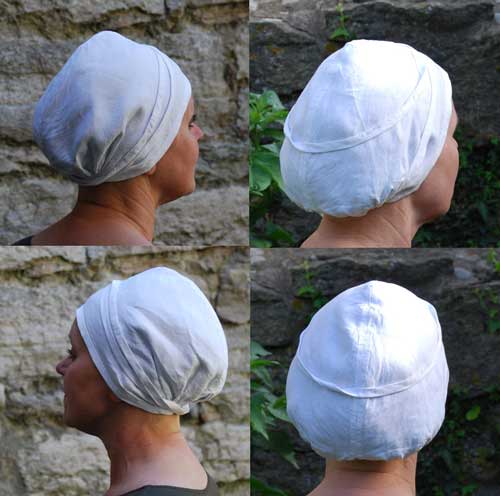
In the latest volume of Medieval Textiles and Clothing Camilla Luise Dahl & Isis Sturtewagen present a new analysis and interpretation of the so-called "St. Birgitta's Coif". They argue, very convincingly, that it is not a coif which ties under the chin (something which is typically associated with men), but a cap where the ties are meant to be drawn backwards towards the back of the head instead, resulting in a headdress that would look a lot like these ones from the Maciejowski Bible.


The cap is made up of two pieces of linen fabric sewn together with interlaced herringbone stitch. 8.5-9 cm is left unseamed at the back, creating a split. The bottom edges are pleated and the cap is edged with an embroidered linen strip that continues on to form the ties. Together, the split and the pleated edges create a "pouch" at the nape of the neck when the cap is worn (Dahl & Sturtewagen, 131-133).

At Historiska Världars forum, a Swedish re-enactment forum, reconstructions of the cap have been discussed over the past few weeks, and since I'm currently making myself a late 13th - early 14th century wardrobe I was inspired to make one myself.

My goal was to use the construction of the Cap of St. Birgitta, make it fit my head (which is a lot bigger than what the original wearer's appears to have been...) and at the same time achieve something that looked like what the women are wearing in the Maciejowski Bible. I found that the biggest obstacle to do this was my hair - there simply isn't enough of it to give any kind of cap that characteristic pear-shape! As Åsa Vävare at Historiska Världars forum clearly demonstrates in this picture, the hair makes all the difference (it's the same cap worn first "without" hair, then "with" hair)...

To make my cap, I first took a measurement from the top of my head to the nape of my neck, i.e. the part of my head the cap would cover. I added 8 cm to the measurement (for the split) and used that as a guide when I cut the curve of the two pieces that make up the cap. I made a cotton mock-up to try out the pattern and promptly discovered that the "pouch" was much too large for my short and very thin hair. The cap sagged and looked pretty sad and deflated unless I used the ties to scrunch it up. And the "scrunched-up" version didn't look much like the images in the Maciejowski Bible. For mock-up no. 2, I only added 2 cm for the split, which resulted in tighter cap with a less pronounced pouch that fit me much better, so I used this pattern for my linen cap.

The finished cap

The final version still looks a little deflated, but that can be remedied with a couple of fake hairpieces...

Fake hair!

I made these braids from unspun flax and they can be arranged in a number of ways to boost my flimsy pigtails; as long as I cover them up properly they work really well, and I too can have at least the semblence of proper hair!

The cap worn with fake braids

It can also be worn with the ears showing, as in most of the images in the Maciejowski Bible:


The decision to make the split very short naturally makes my cap less like the original, with its 8.5-9-centimetre split, but it certainly looks better on me. It's nice and tight, which makes it practical to wear as a foundation for a veil too.

To join the two halves of the cap, I used a scaled-down version of the interlaced herringbone stitch described by Dahl & Lester in Medieval Textiles and Clothing 4. I've never done any kind of interlaced stitch before, so I decided to keep it simple and made the seam rather narrow - unlike the original where it's approximately 1.7 cm wide. The next cap I make will definitely have a more complex embroidery; it was so much fun to try something new!

I haven't had the opportunity to wear my cap for a full day yet, so I don't know how it will work when really put to the test, but for now I'm reasonably pleased with it. With a few more experiments I think I can find a cut that works better for me, but I'm certain I will still need some sort of stuffing to achieve the right shape...


My version of St. Birgitta's Cap


References:
Medieval Textiles and Clothing 4 (eds. Netherton, R. & Owen-Crocker, G. R.):
Dahl, C. L. & Sturtewagen, I. 2008. "The Cap of St. Birgitta", 99-129.
Dahl, C. L. & Sturtewagen, I. 2008. "Appendix 6.1. The Construction of St. Birgitta's Cap", 130-134.
Dahl, C. L. & Lester, A. M. 2008. "Appendix 6.2. The Embroidery on St. Birgitta's Cap", 135-142.

Martinsson, Å. Birgittas huva
(http://www.textilverkstad.se/pdf/funderingar_kring_en_huva.pdf)

Saturday, 2 August 2008

A late 14th - early 15th century outfit

Some time ago I got to model some of my medieval outfits for Svarta Galten, a group that arranges LARP-events (Live Action Role-Play). They wanted pictures of late 14th century clothing as inspiration for the participants of their events, which are set in the fictional, medieval-ish world of Kastaria. The result can be viewed on their homepage, but I thought that I'd put up a few images of my clothes here as well.

Pink dress
(other people might prefer to call it a cotte, a cotehardie, a kyrtle/kirtle or some other word, but I try to avoid using historical terms until there's a clearly defined terminology for medieval garments available)


I'm very happy with this dress. It's made of a wonderful, lightweight, slightly fulled 2/1 wool twill, laces up the front and gives me ample support without being constricting. The bodice is lined with linen to prevent the twill from stretching. Since this photo was taken, I've made the sleeves even tighter by adding buttons to them to make it a little more 'fashionable' (and it's always nice to be able to roll up your sleeves when you do the dishes...).

I make all my tailored medieval clothing by fitting them onto myself and adding gores; the pink dress is no exception. I do have an assistant - my rather rigid and unsquishable dress dummy, but for the final adjustments and to get the bust support right I need to wear the dress myself. It's a little tricky fitting a dress with no one to help, but it can be done. It also helps to be stubborn, patient and not afraid of pricking yourself with pins...

With the pink dress I wear my shortsleeved

Green over-dress


This over-dress is also made of 2/1 wool twill, but it's heavier than the pink dress and more fulled. I had very little of this fabric so while I wanted to use the short-sleeved dress from Herjolfsnes as a model, I didn't have enough to make the side-gores go all the way to the armscye and had to settle for a simpler cut. I also had to piece the sleeves together from several pieces (a rather common practice in the middle ages). The sleeves are a bit too long in these images so I shortened them a little after the photo session. I haven't seen too many medieval images showing short-sleeved overdresses like this one (short-sleeved without tippets or flared sleeves, that is), so if anyone out there has some art references to share, please drop me a line!

Both dresses are completely handsewn with waxed linen thread.

Photos: Tobias Högström/Svarta Galten

Saturday, 12 July 2008

I think I'm back...

After not having written anything for almost a year, this isn't much of a post, but I just can't stop thinking about how extremely alike Snoopy the dog and my nålbinding socks are!


Monday, 24 September 2007

Weaving with tablets and a rigid heddle

This famous depiction of a weaving woman comes from the 14th century manuscript commonly known as the Codex Manesse (Große Heidelberger Liederhandschrift; Cod. Pal. germ. 848). The first time I saw it a couple of years ago, I thought that the artist didn't seem to know a thing about weaving or tablet weaving (assuming that the hexagonal objects on the warp are tablets and not a levitating warp beam) - the lady's sitting at the wrong end of the warp and, if we're talking about tablet weaving here, what's the rigid heddle doing there anyway? But now when I've thought about it and heard what others have to say, this set-up doesn't seem all that far-fetched anymore.


First of all, the woman's not actually doing any weaving in the picture, so she's not really at the "wrong end". It seems to me she's fiddling with the end of the warp (tightening it, sorting the threads?) , while using her beater to ward off the advances of the kneeling man (monk?) who's got his hand up her skirt. In Ecclesiastical Pomp and Aristocratic Circumstance (2000), Nancy Spies further interprets this situation as the woman actually incorporating the man's hair into the warp (p. 100). Secondly, looking at other medieval pictures of weavers and tablet weavers - and at their modern counterparts too - it's obvious that you can sit pretty much anywhere in relation to the band you're weaving; it's not necessary to have the fell (the woven band) right in front of you as long as you can reach it to beat the weft.

As for the rigid heddle, Spies (2000) describes it as a "heddle/warp spreader" (p. 97, my emphasis), which could explain what it's doing in the middle of a possible tablet weaving warp; it's separating the threads and helping the weaver keep the band even. But there may be another, albeit conjectural function for the rigid heddle.

In The Techniques of Tablet Weaving (Collingwood 1996) I found a description of an unusual way to produce a double-faced 3/1 twill. It's described on pages 166-167 and involves both four-holed tablets used standing on their points and a means to raise and lower alternate tablets to achieve the correct structure.
Collingwood suggests using a stick and leashes tied around the warp for this. There are no indications that this technique was ever used historically, but when I read about combining tablets and leashes like this, I immediately thought of the weaving lady in Codex Manesse - tablets together with a rigid heddle should work just as well as leashes!


The technique was a little tricky to master. For each weft, the shed was split twice - first by the square tablets standing on their points and then by the heddle raising or lowering every alternate tablet - which meant the final shed ended up being very small. It really helped to tilt the warp vertically on its side to get a better view of the shed. In various medieval manuscripts band weavers can be seen working with the warp in this position and I can verify that it really makes sense to do that if the shed's unclear!

The finished sample is approximately 2 cm wide and the front and back are shown here next to each other (I used thick cotton yarn, so it looks kind of rough).

Weaving with tablets and a rigid heddle on the same warp creates many new possibilities! For example, I tried it with two-holed tablets and managed to produce a nice little piece of double weave, combining ordinary interlaced twill with tabby. It might not be a historical technique or the most efficient way to weave complex structures, but for someone like me who loves all the technical stuff behind both tablet weaving and ordinary weaving, it's great fun!


References:
Collingwood, P. 1996. The Techniques of Tablet Weaving. McMinnville: Robin & Russ Handweavers, Inc.

Spies, N. 2000. Ecclesiastical Pomp and Aristocratic Circumstance. A Thousand Years of Brocaded Tabletwoven Bands. Jarrettsville: Arelate Studio.